(Last updated: 05/07/2026)
While linear television is steadily losing relevance with certain audiences, the use of streaming services continues to grow. For brands, this means streaming environments enable a far more precise approach to reaching audiences than classic TV. This paradigm shift takes us away from the classic "one-to-many" principle toward data-driven, significantly more precise audience targeting — toward Connected TV.
Classic TV
Broad reach
High wastage
Amazon CTV
Based on purchase data
Exact audience
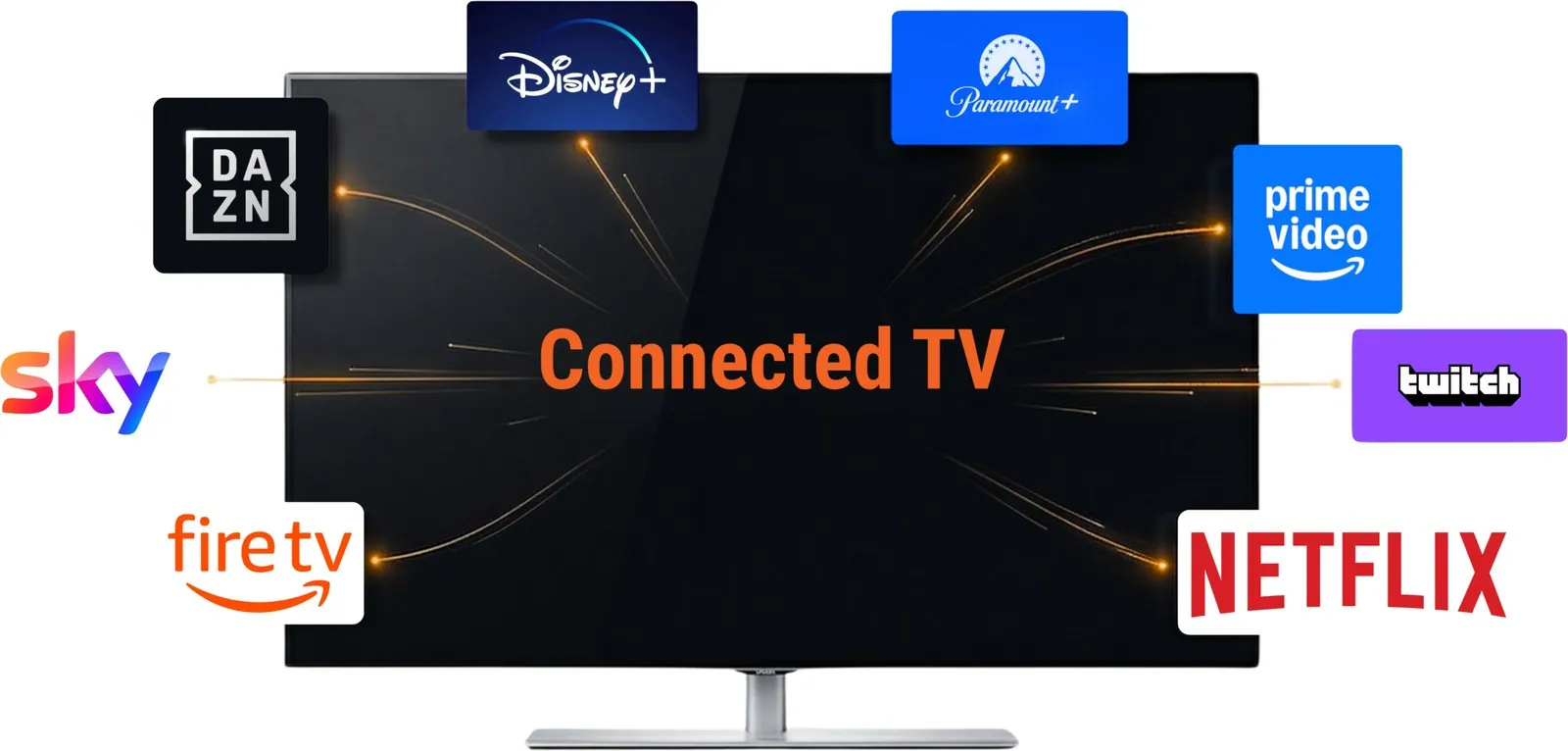
In an increasingly fragmented streaming market, advertisers face the challenge of not losing their audience across countless apps. This is exactly where the Amazon DSP plays its greatest strength: it bundles the most important players, such as Prime Video, Disney+, Netflix, Sky, and DAZN, in one central place. Instead of laborious individual bookings, you use a "unified inventory" to efficiently maximize your reach within the media plan. Connected TV (CTV) is now the next logical step for sellers and vendors looking to scale their visibility beyond Amazon search alone. Anyone neglecting their presence on the biggest screen in the house is leaving valuable touchpoints in the living room untapped. After all, Amazon accompanies users throughout the entire day – from morning music via Alexa to primetime on the smart TV.
The foundation: hardware, content, and the "one-stop shop"
To use Connected TV (CTV) strategically, you first need to understand the infrastructure. This is where technical devices meet a variety of content models.
→Hardware vs. streaming content
Connected TV definition: CTV refers simply to the internet-capable device – from the smart TV to the games console. The actual content consumed via these devices is defined as STV (Streaming TV). In practice, we distinguish between three ad-relevant models above all:
SVOD (Subscription Video-on-Demand)
Subscription-based services where users get unlimited access to ad-free (or reduced-advertising) content for a fixed monthly fee (e.g. Netflix, Disney+, or classic Apple TV+).
AVOD (Advertising Video-on-Demand)
Ad-supported on-demand content (e.g. Prime Video).
FAST (Free Ad-supported Streaming TV)
Free, linear channels that resemble classic TV stations but run over the internet.
Prime Video dominates this market and records the highest ad-funded VOD reach share in Germany for both entertainment (68%) and live sport (60%). The fact that this is no longer a niche phenomenon is shown by the reach of already 71% of ad-supported streaming viewers (Source: Amazon Ads internal data).
→The Amazon DSP as the central access point ("unified inventory")
The Amazon DSP acts as a hub that gives you access to the so-called "unified inventory." This is a one-stop shop for a broad, continuously growing streaming inventory that extends far beyond Amazon:
- Amazon O&O (Owned & Operated): Exclusive placements on Prime Video, Twitch, or the Fire TV News app.
- Third party (3P): Access to premium apps such as Disney+, Netflix, Sky, or Paramount+, as well as FAST providers like Pluto TV, Rakuten, and Samsung TV Plus. The integration of RTL+ and HBO Max will further expand reach going forward.
Specifically for Fire TV CTV devices, this results in strategic placements for sellers and vendors:
Inline banner
Placed on the Home and Live tabs, visible while users spend an average of 10 minutes browsing for content.
Sponsored screensaver
Appears when the device has been inactive for 5 minutes and offers an interactive full-screen experience that can link to landing pages or Fire TV Brand Destinations.
Feature rotator
Placed centrally on the home screen, with an 89% video completion rate for high attention.
Twitch is also evolving rapidly. Contrary to the myth that it's purely a gaming platform, non-gaming content already accounts for 30% of content consumed. For mobile-first audiences, especially Gen Z, who watch 72% of their evening videos vertically, Amazon Ads has launched the vertical video ad format (9:16) on Twitch and Online Video (OLV) (Source: Amazon Ads internal data).
→Insider strategies: from guarantee to flexibility
A key advantage of buying through the DSP lies in the various deal structures. Top placements for high-reach events can be secured in advance via Programmatic Guaranteed (PG) or Preferred Deals (PD) – ideal for planning certainty on large campaigns. Private auctions, on the other hand, provide maximum flexibility and attractive pricing. This interplay is especially crucial in live sport environments (e.g. DAZN or NBA), to be present at exactly the right time.
CTV – internet-capable devices
- Smart-TVs
- Sticks
- Games consoles
STV – streaming content models
- SVOD
- AVOD
- FAST
Unified inventory sources – streaming platforms
Prime Video · Twitch · Fire TV News
Disney+ · Netflix · Sky · Paramount+
Precision beats chance: why Amazon CTV is superior
The true edge of Amazon Connected TV lies in the intelligence of the data. While conventional television relies on rough estimates and vague panel data, your advertising here is backed by real first-party (1P) purchase and search signals as well as streaming activity and browsing patterns on Amazon platforms.
→Maximum efficiency through intelligent frequency management
A common problem with streaming advertising is "viewer resistance" – when users see the same spot repeatedly across different apps. Amazon solves this with the "Unified EU Video Buying" approach:
- Cross-app capping: Contact frequency is managed centrally across all apps used.
- Cost advantage: This reduces contact overload and enables efficiency gains of up to 26% (Source: Amazon Ads internal data).
→Incremental reach and brand safety
Connected TV advertising is key to reaching "cord-cutters" (users without a cable subscription). AI-driven optimizations can increase reach by around 21% without increasing budget (Source: Amazon Ads internal data). The combination of Amazon inventory and third-party providers even increases the number of unique users reached by 2.3x compared to using Amazon inventory alone (Source: Amazon Ads internal data). At the same time, you retain full control over your brand's environment:
- Targeting: Based on aggregated purchase and search signals rather than pure guesswork.
- Brand safety: Detailed content ratings (age ratings 0 to 18) let you decide exactly which content context your spot fits into.
→ Xingu expertise check
How strongly these effects play out in your specific setup depends on budget and campaign structure. If you'd like to know how we can put these levers to work for you, feel free to get in touch. We'll help you drive your brand visibility forward.
Interactive video ads: from the spot straight to the cart
Connected TV advertising today is far more than a passive medium. Through Interactive Video Ads (IVA), viewers can interact directly with your brand via remote control or QR code. Willingness to interact increases by 86% when viewers are exposed to an interactive format (Source: Amazon Ads internal data). You can also rely on the following interactive formats:
Real-time deal badging
Automatic display of active deals (e.g. Prime Day alerts) directly in the ad overlay.
Headlines send to phone
Direct transition from the TV to an external landing page via a "send to phone" notification – ideal for brands selling outside of Amazon.
Interactive pause ads
A display ad that appears when the viewer pauses their Prime Video session.
Your spot should therefore not only be emotionally compelling, but also demand a clear action.
→ How to optimize your spot
For your video to work on the "big screen," you should follow these three golden rules:
Immediate branding
Place your logo within the first three seconds. Attention in the living room is high, but fleeting.
Active guidance (CTA)
Use a QR code or a prompt on the remote control as a clear call to action.
Use trust anchors
Integrate Amazon badges (e.g. the Prime logo). This directly boosts credibility on the TV.
Measurability: shedding light with the Amazon Marketing Cloud (AMC)
Measurability was long the Achilles' heel of TV advertising – today it's the most important lever for budget optimization. With the Amazon Marketing Cloud (AMC), we analyze the actual impact a smart TV touchpoint has on sales. A key aspect here is the halo effect: CTV often acts as the first touchpoint (upper funnel), which triggers a later search on the smartphone (lower funnel). Thanks to AMC, this path from the couch to the cart becomes transparent. This lets us evaluate the total ROAS of your campaign across all devices.
TV contact (awareness)
CTV spottriggers a follow-up search
Cross-device interaction (consideration)
Search started or ad clickedPath visible via AMC
Cart (conversion)
Purchase completedCross-channel ROAS measurable
Strategy: your path to smart TV success
Connected TV is the bridge between the brand feel of television and the precision of digital data. It is especially well suited to brands with products that require explanation, or brands looking to dominate their niche. However, the complexity of topics such as Unified EU Video Buying or AMC queries requires experienced management.
In 2026, Connected TV is no longer an experiment but an indispensable standard. Anyone who combines streaming, live sport, and data-driven strategies today secures a decisive edge in the fight for attention – before the competition claims the living room.
FAQ – frequently asked questions about Amazon Connected TV
A smart TV is the device with a built-in system. Connected TV (CTV) is the umbrella term for all internet-capable televisions – including those that go online via a Fire TV Stick or a console. Via the Amazon DSP, we reach both user types equally.
No, it is rather a necessary complement. While classic TV provides broad background awareness, CTV delivers the precision needed to reach audiences with specific purchase intent.
Yes, geo-targeting within the Amazon DSP allows control down to the postcode level in Germany.
Using modern production techniques and AI-powered tools, high-quality spots can now be created significantly more cost-efficiently than classic TV productions. We're happy to support you with the creative execution.
Thanks to the Amazon Marketing Cloud (AMC), you no longer measure success in vague ratings, but through the direct link between TV touchpoints and later purchases across all devices. This makes the "halo effect" visible – i.e. how many customers specifically search for your brand and land in the cart after seeing your spot.