From this date the tightened rules apply across all digital sales channels.
The EU is tightening competition law and consumer law at the same time.
Marketing claims that will be banned on Amazon listings without exception.
The action plan for checking and cleaning up your catalogue in time.
E-commerce brands, Amazon vendors and marketplace sellers are facing serious new legal rules for product communication. With the EmpCo Directive (EU) 2024/825 — also known as the ECGT Directive (Empowering Consumers for the Green Transition) — the European Union is putting a definitive end to uncontrolled "greenwashing".
In Germany, the European legal act takes effect through the Third Act Amending the UWG (the law against unfair competition) and accompanying changes to consumer law. From 27 September 2026, the tightened rules must be applied across all digital sales channels.
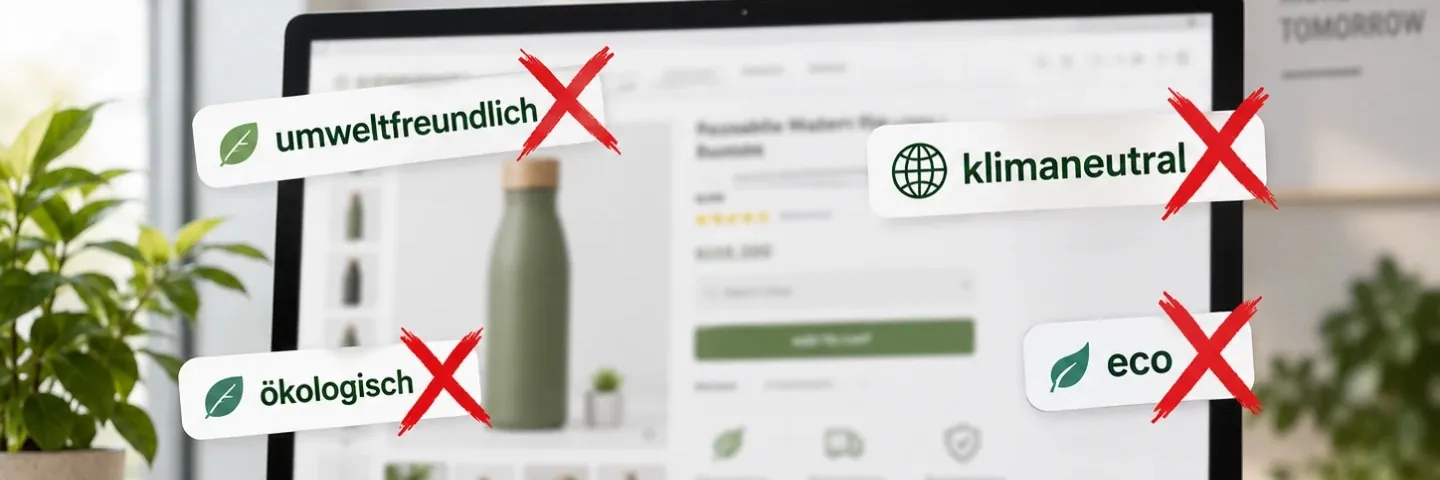
Whether in bullet points, on product images, in A+ modules, in the Amazon Brand Store or in content syndication via PIM systems: anyone still using unsubstantiated phrases such as "climate-neutral", "environmentally friendly" or "ecological" risks immediate cease-and-desist letters under unfair competition law, as well as painful account suspensions on marketplaces.
No time to read it all? Have your Amazon listings checked for greenwashing risks straight away.GET A NO-OBLIGATION AUDIT
What do the EmpCo / ECGT requirements mean for e-commerce businesses?
To pave the way towards a more sustainable circular economy, EU Directive 2024/825 (ECGT) tightens two fundamental pillars of European consumer law:
- The Unfair Commercial Practices Directive (2005/29/EC)
- The Consumer Rights Directive (2011/83/EU)
The legislator's aim is for consumers to receive reliable, clear and verifiable information at the point of sale. When purchase decisions are based on genuine environmental benefits, fair competition emerges for the companies that really do invest in sustainable products.
The two pillars of EmpCo regulation at a glance:
- Tightened competition law (UWG): an immediate ban on blanket environmental claims without proven top environmental performance, the removal of uncertified sustainability labels, and a stop to climate-neutrality claims that rest purely on external carbon offsetting.
- Extended information duties at checkout & in the product listing: new, EU-wide harmonised requirements for presenting statutory warranty rights, specific labelling for long-term manufacturer guarantees, and transparent mandatory data on software updates and spare-part availability.
The underestimated risk: visual greenwashing
Many retailers and brand manufacturers feel safe, believing EmpCo only concerns body copy. That is a dangerous misconception. In legal terms, a green claim is any representation — including graphics, icons, colour schemes, packaging motifs or symbols — that suggests an ecological or climate-related benefit. A green leaf symbol on the Amazon product image, an eco button staged through colour, or an invented "eco-friendly" icon in A+ content all fall under the strict burden of proof of the ECGT Directive from September 2026.
The 5 central greenwashing traps for Amazon listings
The additions to the European "black list" of unfair commercial practices (Annex I of Directive 2005/29/EC) set out precisely which marketing claims will be prohibited without exception:
A. General environmental claims without top environmental performance
Blanket claims where the concrete environmental benefit is not explained directly and prominently on the same medium are not permitted. Classic examples:
- "environmentally friendly", "green", "ecological"
- "climate-friendly", "CO₂-friendly", "bio-based"
- "energy-efficient", "biodegradable"
The exception: such a claim is only still permitted if the product can demonstrate recognised excellent environmental performance that matches the claim exactly. This includes, for example, the verified EU Ecolabel, state-recognised eco-labels under EN ISO 14024 Type I, or the highest energy efficiency class A under EU law.
B. The scope trap ("part vs. whole")
It is expressly prohibited to make an environmental claim about the entire product when the benefit in truth relates only to one aspect or to the packaging.
- Example: advertising a charging cable with the claim "made from 100% recycled material" when only the outer carton is made of recycled paper is a clear breach of unfair competition law.
C. Carbon offsetting claims
One of the most far-reaching changes concerns climate-neutrality claims. Statements such as "climate-neutral", "carbon-offset" or "climate-positive" are prohibited where that effect is based on buying carbon certificates or offsetting projects outside your own value chain. Buying your way out of emissions through reforestation projects is no longer enough to advertise a product as "climate-neutral".
D. Unofficial "fantasy labels"
Applying sustainability labels, quality marks or badges will be prohibited unless they are based on a transparent, independent third-party certification scheme or have been established by public authorities. Self-created graphics with wording such as "Green Choice" or "Eco Approved" are therefore off limits.
E. Advertising legal requirements as a benefit
It is prohibited to promote properties as a special achievement when they are legally required anyway for all products in that category on the EU market.
- Example: advertising fabric softener as "BPA-free" when BPA has long been banned by law in that category.
Don'ts & do's: concrete practical examples for Amazon
To help your content team adapt listings in a legally sound way, the following comparison is useful:
| Previous claim (don't) | Legally compliant example wording (do) | Required basis / evidence |
| "Green & environmentally friendly headset" | "Housing consists of 65% certified recycled plastic." | Material certificate from the supplier & specification directly alongside the claim. |
| "Climate-neutral product through carbon offsetting" | "Manufacturing-related carbon footprint reduced by 15% (2.4 kg CO₂e per unit). Plus investment in external climate projects." | Strict separation of real performance within the value chain and external offsetting. |
| "Includes our Eco-Protect label" | "Certified to the EU Ecolabel (licence no. XXX/YYY)." | Independent certification scheme in line with ISO 17065 / state label. |
| "Sustainable smartphone case" | "Retail packaging made from 100% recycled cardboard, printed with soy ink." | Precise limitation to the element that actually has the property. |
Unsure which claims are still allowed on your Amazon listings? We are happy to help.CHECK LISTINGS NOW
Tighter rules for tech & electronics retailers: software, repairability & durability
For retailers of consumer electronics, household appliances or smart home products, the EmpCo / ECGT Directive goes far beyond green claims. The EU is taking targeted action against artificial product wear (planned obsolescence) and a lack of repair transparency:
Prohibited practices for hardware & software:
Concealing the consequences of updates
if a software update negatively affects a device's performance or battery life, that information may not be withheld from the buyer.
False update necessity
a feature extension may not be presented as a mandatory security update.
Artificial durability limits
deliberately building in features that limit service life, or falsely assuring a particular durability, is prohibited.
Premature replacement of consumables
printer messages prompting a replacement when the cartridge is not technically empty will no longer be permitted.
Restrictions with third-party products
if a manufacturer conceals that functionality is restricted when accessories or charging cables from other brands are used, they breach the law.
Mandatory information at checkout & on the product detail page:
Harmonised warranty notice
a clear reference to the statutory two-year warranty right in the EU-wide colour design.
Harmonised label for durability guarantees
if the manufacturer offers a free commercial durability guarantee of more than two years for the entire product, the retailer must highlight this with the new official EU label.
Software update periods
stating the minimum period (in years or as a date) for which the manufacturer guarantees free updates.
Repairability score & spare parts
where an EU repairability score exists, it must be displayed — as must data on the availability and estimated cost of spare parts.
Syndication & content responsibility: who is liable on Amazon?
Many brands distribute their product data automatically to retailers and marketplaces via PIM systems or syndication platforms such as Loadbee. A dangerous liability trap lurks here:
The brand manufacturer
carries full legal responsibility for the accuracy, lawfulness and EmpCo compliance of all data, copy and media submitted.
Platforms & syndication providers
act legally as pure hosting providers and carry out no legal review of the content.
Marketplace (Amazon)
reacts rigidly to competition-law warnings and suspends affected ASINs or storefronts swiftly to avoid its own liability risks.
Full responsibility for the lawfulness of all assets therefore remains with the manufacturer.
Action plan: EmpCo compliance in 5 steps
To make sure you act in time before 27 September 2026, the following systematic approach is advisable:
Inventory audit
systematically search all active listings, A+ graphics, brand store pages, product uploads and packaging views for buzzwords ("green", "climate-neutral", "eco") and visual symbols.
Filter & specify claims
delete blanket statements or replace them with concrete, verifiable facts (for example exact recycled-content percentages).
Clean up visual assets
remove self-created labels, environmental badges and graphics referring to offsetting from the image stacks and A+ layouts.
Anchor structured product data in the PIM
extend supplier feeds and PIM databases with new mandatory attributes such as software update periods, spare-part availability and durability guarantees.
Establish approval processes
embed compliance standards in the content creation workflow so that new image and text assets are automatically checked for EmpCo / ECGT compliance before upload.
FAQ – frequently asked questions about the EmpCo Directive
Directive (EU) 2024/825 must be applied by all market participants in all EU member states from 27 September 2026.
No, they are not banned outright, but they are tied to extremely strict conditions. A general claim such as "environmentally friendly" is only permitted if officially recognised excellent environmental performance (for example the EU Ecolabel) can be demonstrated for the product. Without such evidence, the claim is not permitted.
The German implementing act provides no explicit use-up or sell-off period for packaging already printed, or for existing stock, after 27 September 2026. Anyone continuing to use packaging with unlawful claims on images or on the product risks cease-and-desist letters from that date.
When does the EmpCo / ECGT Directive apply?
Will terms such as "environmentally friendly" be banned completely from September 2026?
Is there a transition or sell-off period for old packaging?
Why wait? Have our experts examine your priority products and top ASINs right away.START A FREE AUDIT